WIA Philanthropy Spotlight: Comfort Ayikoru 2026 Young Leader
DISCOVER THE NEW WIA YOUNG LEADERS 2026
6 November 2026
Our 2026 Spotlight Series continues, and today we celebrate you, Comfort!
Can you tell us briefly who you are and what you do?
My name is Dr. Comfort Ayikoru, a Ugandan medical doctor, public health practitioner, and co-founder and CEO of BuriCare Limited, a med-tech social enterprise developing affordable, locally made neonatal care solutions for premature and vulnerable babies. I am also a researcher with the Academy for Health Innovation at the Infectious Diseases Institute in Uganda, where I work on evaluating digital health innovations. Through my work, I am passionate about making healthcare more accessible, equitable, and responsive to the needs of underserved communities, particularly mothers and newborns.
What inspired you to start your journey or project?
BuriCare was born out of a deeply personal loss. During the COVID-19 pandemic, my niece was born prematurely at a health facility without a neonatal intensive care unit. We were referred to a regional hospital, but during the journey, her body temperature dropped without us realising how dangerously low it had become. By the time we arrived, she had passed away in my hands.
As a medical doctor, that experience changed me. Later, during my clinical training, I witnessed other families experience similar losses, often because of gaps in infrastructure, limited resources, and inadequate monitoring. I realised I could not simply accept these challenges as inevitable. I wanted to help build practical, affordable solutions that could make a difference in the lives of vulnerable babies and their families. That conviction became the foundation of BuriCare.
What are the key achievements or milestones you’re most proud of?
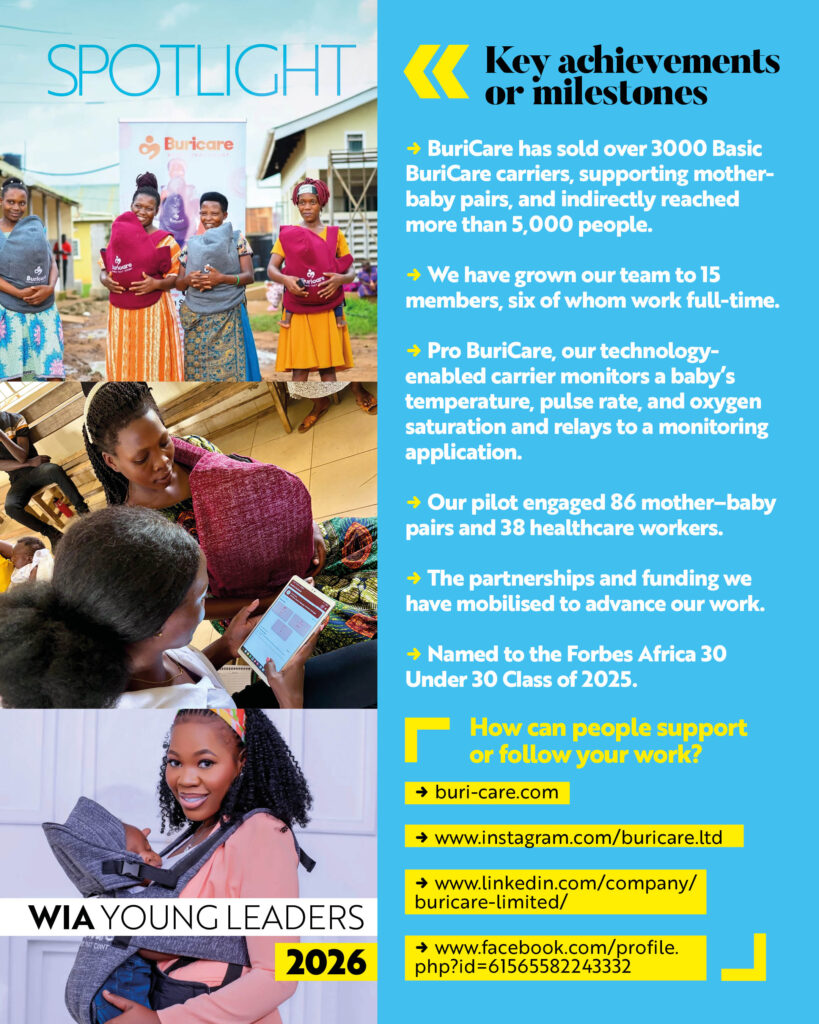
I am proud that we have transformed an idea born out of loss into a growing social enterprise with tangible impact. To date, BuriCare has sold over 3000 Basic BuriCare carriers, directly supporting mother–baby pairs, and indirectly reached more than 5,000 people through community outreach programmes conducted with hospital partners in Uganda. We have grown our team to 15 members, six of whom work full-time.
We have also developed and piloted Pro BuriCare, our technology-enabled carrier that monitors a baby’s temperature, pulse rate, and oxygen saturation and relays readings to a mobile application for remote monitoring. Our pilot engaged 86 mother–baby pairs and 38 healthcare workers, generating valuable feedback to guide further refinement. I am equally proud of the partnerships and funding we have mobilised to advance our work, and of the recognition BuriCare and my leadership have received, including being named to the Forbes Africa 30 Under 30 Class of 2025.
Can you share with us one personal quote or belief that guides you?
“Your circumstances may shape where you begin, but they do not have to determine how far you can go.”
I believe that meaningful change often begins with a problem we cannot ignore and the courage to do something about it, even when we do not yet have all the answers or resources.
What advice would you give to other young women who want to create impact?
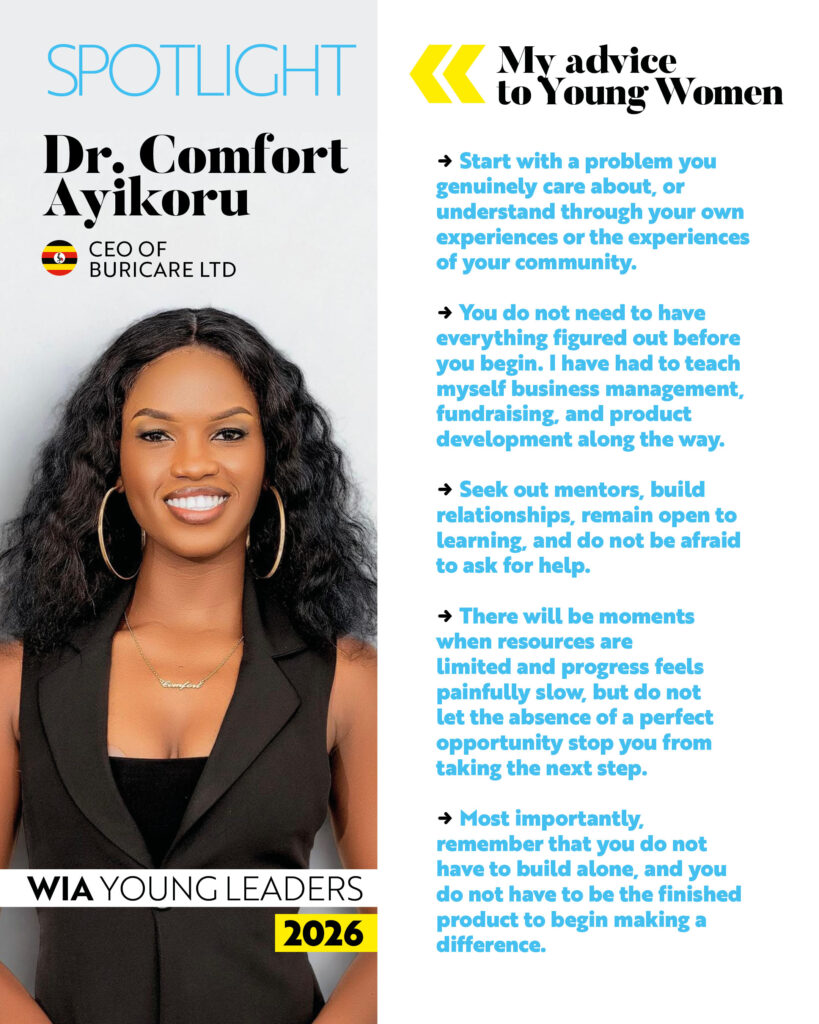
Start with a problem you genuinely care about, especially one you understand through your own experiences or the experiences of your community. You do not need to have everything figured out before you begin. I started as a medical doctor with no formal training in entrepreneurship, and I have had to teach myself business management, fundraising, and product development along the way.
Seek out mentors, build relationships, remain open to learning, and do not be afraid to ask for help. There will be moments when resources are limited and progress feels painfully slow, but do not let the absence of a perfect opportunity stop you from taking the next step. Most importantly, remember that you do not have to build alone, and you do not have to be the finished product to begin making a difference.
What are you currently working on or planning next?
We are focused on strengthening both arms of BuriCare. For our Basic carrier, we plan to expand distribution into 5 additional districts in Uganda over the next year, with the longer-term ambition of reaching more than 10,000 mother–baby pairs through direct sales and expanding into other East African countries, starting with Kenya.
For Pro BuriCare, we are refining the product based on feedback from our pilot and preparing for a wider clinical validation study across five additional hospitals in Uganda, with the ambition of reaching 1,000 mother–baby pairs. We also hope to generate rigorous evidence on its safety, performance, feasibility, and potential to strengthen continuity of neonatal care. Ultimately, our goal is to make affordable, technology-enabled neonatal care accessible to more families who need it most.